
A crawl flags two hundred duplicate titles. Some are the same document reached through tracking parameters; others are distinct guides that inherited a generic template title. Rewriting all two hundred strings would hide the difference. Diagnose the URL relationship and the metadata source before deciding which pages need new copy.
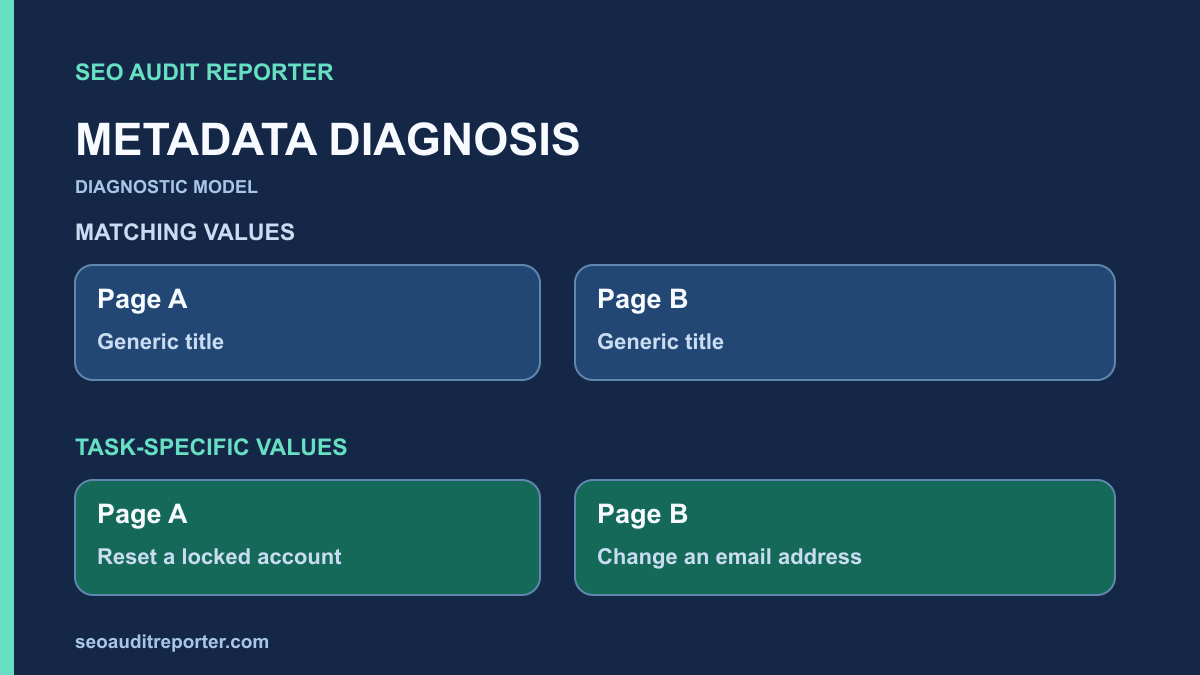
Understand what the duplicate report actually measures
A crawler usually groups URLs whose extracted title or description values match according to its comparison rules. That is a text comparison, not a complete assessment of search intent, content duplication, or indexing. Check whether the tool trims whitespace, changes case, or includes redirected and nonindexable pages.
A title element and a meta description also have different roles. Google’s title-link guidance describes several sources it can use for a displayed title. Its snippet guidance explains that snippets can come from page content and may use a description when it is suitable. Your supplied text is not guaranteed to appear unchanged.
Keep the audit focused on accurate, distinguishing metadata for intended public pages. Do not claim that every duplicate description causes a ranking penalty. The useful question is whether metadata helps identify the actual page and whether duplication reveals a deeper template or URL problem.
Collect enough fields to explain each group
Export URL, response status, canonical target, indexing directives, title, description, heading, and page type. Include the final URL after redirects. Preserve empty fields so missing metadata remains distinguishable from a repeated nonempty value.
Run the crawl with a recorded scope and rendering mode. A title injected by JavaScript can differ from the original HTML, and a tool configured differently after repair may report a change that the deployment did not cause. Review representative source and rendered documents when extraction looks inconsistent.
For each duplicate group, count intended canonical pages separately from alternate URLs. This reduces a large parameter inventory to the actual set of publishing decisions. Use the technical audit process to keep status, rendering, and inventory checks consistent with the broader investigation.
Classify duplicates before rewriting metadata
Alternate URLs for one document
Tracking parameters, protocol variants, and old redirected addresses can represent the same content. If the intended canonical relationship is correct, a matching title may be entirely expected. Review links and URL generation rather than inventing unique descriptions for every alternate address.
When the relationship is unclear, follow the canonical audit. Compare content, canonical declarations, redirects, internal links, and sitemap membership. Metadata changes should not be used as a workaround for conflicting preferred-URL signals.
Distinct pages using a generic template
Several unrelated articles titled “Resources” usually indicate a template fallback, missing field, or plugin configuration problem. Inspect the content model and the generated head section. Determine whether editors saved unique titles that the public template never outputs.
Fix the shared cause before editing every page. A template may read the wrong field or override a carefully entered SEO title. After repair, confirm that pages with explicit values use them and that pages without values receive a useful fallback rather than a blank title.
Separate pages with substantially overlapping intent
When the pages themselves answer the same question, different metadata will not create a meaningful distinction. Compare their scope, audience, and main content. A content owner may choose to clarify the purpose of each page or consolidate them through a planned editorial process.
Do not delete one page simply because the titles match. A product specification and a troubleshooting page can share a topic while serving different tasks. Establish what each page contributes before proposing a URL change, consolidation, or a new title.
Inspect the real metadata source
On a CMS site, inspect the page title field, SEO plugin fields, template patterns, and rendered head output. Determine the precedence between them. A saved value in the editor is only input; the public HTML is the result that must be verified.
Check whether multiple systems emit title or description elements. A plugin and custom template can produce conflicting duplicates within one document, which is different from matching metadata across documents. Record element counts as well as extracted values.
For dynamically rendered pages, compare an ordinary GET response with the browser DOM. A script that replaces the title after loading can complicate previews and audits. Keep the intended source of truth clear and avoid adding another metadata producer to solve a conflict between the existing ones.
Retain a representative head-section sample before the repair. It gives developers a direct comparison when an editor’s saved value and the generated output disagree.
Write titles that distinguish the reader’s task
Describe the specific topic and purpose of the page in plain language. Use the page’s actual scope rather than appending a random number or a synonym solely to pass a duplicate check. A diagnostic guide should say which problem it helps investigate.
For a hypothetical help center, “Account Help” on every page conceals useful distinctions. “Reset a Locked Account” and “Change the Account Email Address” identify different tasks. These are illustrative titles, not claims about search demand or guaranteed click improvements.
Use a consistent brand treatment where it helps identify the site, but leave room for the actual subject. Google’s guidance does not establish a universal character limit that guarantees an untruncated title. Evaluate clarity and preview behavior without treating a fixed count as a ranking rule.
Write descriptions that match the actual answer
Summarize the page’s useful information or diagnostic outcome. Avoid boilerplate that could describe every page in the section. A description promising a downloadable checklist should only make that promise if the page actually provides one.
A concise description is useful for editorial consistency, but no fixed length guarantees how a search snippet will appear. A practical target can guide writing without forcing unnatural sentences. Preserve accuracy when a meaningful description needs a little more or less space.
For large templated inventories, use structured fields that genuinely vary, such as product type or the task covered. Review samples across combinations. Do not fill missing data with repeated promotional language that recreates the original duplication in a different form.
Handle pagination and filter pages deliberately
Review whether each paginated page exposes different items and whether it is intended to be indexed. Page identifiers can help readers distinguish members of a series, but they do not resolve an incorrect canonical policy. Check the page relationship before adding numbering.
Filter pages require a similar decision. An intentionally public landing page with distinct value may need its own title and description. A temporary sort variant may reasonably share the underlying document’s metadata. Maintain one policy across canonical declarations, links, indexing controls, and metadata generation.
Prioritize the fix by reach and confidence
Repair a demonstrated template override affecting important public pages before polishing descriptions on rarely used alternates. Separate missing metadata, inaccurate metadata, and harmless matching metadata in the issue list. These groups have different owners and acceptance checks.
Use the prioritized fix-list method to record affected templates and evidence. Avoid assigning severity only from the raw duplicate count. Hundreds of alternates can produce a larger count than a small but consequential set of misleading public titles.
Verify the published output and regression risk
Fetch the changed URLs publicly and confirm the title and description element counts, actual text, and encoding. Check that quotes, ampersands, and non-English characters survive correctly. Compare the title with the visible heading and main content for consistency.
Repeat the same crawl and use the crawl comparison to review expected and unexpected changes. Sample pages with explicit metadata, fallback values, pagination, and empty optional fields. A fix should preserve legitimate exceptions instead of forcing every page into one rigid pattern.
Keep the original duplicate group, its classification, the generating rule, and the verified public values in the report. Later search titles or snippets may differ from your supplied text. Treat that as a separate search-result observation rather than proof that the CMS failed to save the repair.